| | 
The more knowledge we have about the land we detect the better our chances of making significant finds – research is a powerful tool and this book will prove invaluable to anyone who is serious about metal detecting.
What is a field-name, how did it obtain its name, when was it named, has the name changed over the centuries and what does it mean? These are some of the fundamental questions which this book will help to answer, giving an insight into past lives, land management and usage.
This fascinating book explores the roots of field names, many of which contain hidden meanings referring to long-lost practices involving myths, legends, and customs.Historians, archaeologists, metal detectorists, fieldwalkers and anyone interested in the social history of the United Kingdom will find this book a fascinating read.
This book offers a new and exciting dictionary style format. The author has drawn on a wide range of literature covering: archaeology, biology, entomology, etymology, genealogy, geology, history, mathematics, mineralogy, mythology, sociology, technology, and flora and fauna, to name but a few subjects.
ISBN: 1897738595 / 978-1897738597 |
| | | 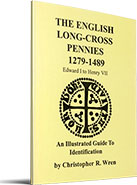
The English Long-Cross Pennies 1279-1489 by Christopher R. Wren
Paperback, 196 pages
This volume covers Edward I to Henry VII and is part of Christopher Wren’s invaluable trio of guides to Medieval pennies which were first published in the 1990s and are intended as an introduction to assist new collectors and detectorists alike in classifying the coins.
These books give a brief historical context of the short cross coinage and the development of the classification system in used today. Information from the original written records has been invaluable in establishing a chronology, and in placing coins of the different types in sequence.
These Royal Numismatic Society Lhotka Prize winning titles are packed full of practical information on this extensive English medieval penny series. They includes tables and many drawings, together with a detailed bibliography for further reading, and notes on such subjects as legend errors, continental imitations and the related issues from Scotland and Ireland.
|
| | | 
The Voided Long-Cross Coinage 1247-1279 by Christopher R. Wren
Paperback, 88 pages
This volume covers coinage of Henry III & Edward I and is part of Christopher Wren’s invaluable trio of guides to Medieval pennies were first published in the 1990s and are intended as an introduction to assist new collectors and detectorists alike in classifying the coins.
These books give a brief historical context of the short cross coinage and the development of the classification system in used today. Information from the original written records has been invaluable in establishing a chronology, and in placing coins of the different types in sequence.
These Royal Numismatic Society Lhotka Prize winning titles are packed full of practical information on this extensive English medieval penny series. They includes tables and many drawings, together with a detailed bibliography for further reading, and notes on such subjects as legend errors, continental imitations and the related issues from Scotland and Ireland.
|
| | | 
The Short-Cross Coinage 1180-1247 by Christopher R. Wren
Paperback, 96 pages
This volume covers coinage of Henry II to Henry III and is part of Christopher Wren’s invaluable trio of guides to Medieval pennies which were first published in the 1990s and are intended as an introduction to assist new collectors and detectorists alike in classifying the coins.
These books give a brief historical context of the short cross coinage and the development of the classification system in used today. Information from the original written records has been invaluable in establishing a chronology, and in placing coins of the different types in sequence.
These Royal Numismatic Society Lhotka Prize winning titles are packed full of practical information on this extensive English medieval penny series. They includes tables and many drawings, together with a detailed bibliography for further reading, and notes on such subjects as legend errors, continental imitations and the related issues from Scotland and Ireland.
|
| | | 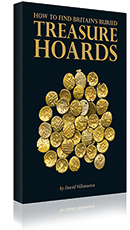
How to find Britain’s Buried Treasure Hoards by David Villanueva
Every detectorist dreams of finding a hoard and this new book by celebrated author David Villanueva will increase your chances of doing so.
The rich history of the British Isles has led to the burial of thousands of hoards for many different reasons - some as offerings, some as savings or in an emergency, intended to be recovered later. Although of course nobody knows exactly where hoards are buried, understanding why hoards came to be in the ground will help you to search in the right places.
Covering the Bronze Age to modern times, this fascinating book also gives lots of advice on how to research possible hoard sites, from researching local maps and records to clues to look out for on google earth.
Chapter Headings:
- Tools & Resources
- The Bronze Age
- The Iron Age
- Roman Britain
- Saxons & Vikings
- Medieval Britain
- Religious Houses
- Battle Sites
- Modern Times
- Treasure Law
152 pages, A4, £22.95
ISBN 9781897738627
|
| | |  **NEW TITLE OCTOBER 2024** **NEW TITLE OCTOBER 2024**
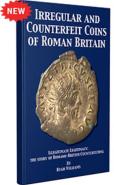
Irregular & Counterfeit Coins of Roman Britain
Illegitimate legitimacy, the story of Romano-British counterfeiting
by Hugh Williams
A4 softback, 108 pages, full colour. £22.00
By far the most common coins found by detectorists are the Romano-British copies of the third and fourth centuries. They are often described as 'barbarous radiates' or even more disparagingly as 'Roman grots'. These little bronze offerings have a charm of their own and deserve more than to be condemned to a detectorist’s junk box or ignored by numismatists and archaeologists as being unimportant. The purpose of this book is to highlight some of the more interesting copies from Roman Britain and to show that they too tell a story. They form miniature pieces of art made by local British artisans for use by the Romano-British population.
This book aims to illustrate the range of copies found in a way that will be of interest to numismatists, archaeologists, collectors and detectorists – it aims to foster in the reader an appreciation of an important aspect of the art of Roman Britain, and consign the description 'grots' to never ending banishment.
|
|
|